
Event hosting is an act of craftsmanship. There’s a reason the term Socialite exists, and it’s not as easy as hanging out and partying. There are several levels in how meaningful an event is for attendees, and it usually depends on the skills of the host. Here are the 5 levels, as I see them.
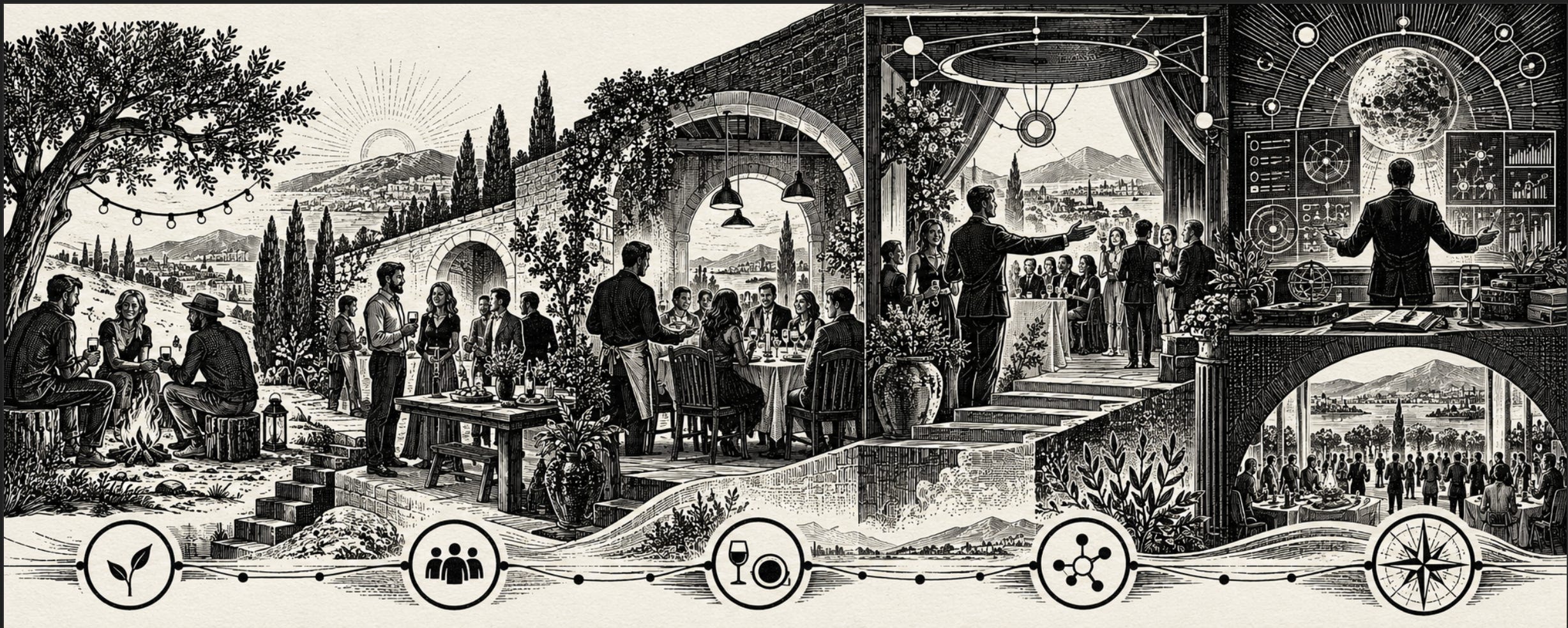
Level 1: Just people together in a space
Anyone can come, anyone can participate, it’s just acceptable enough to be good enough for everyone, but special to no one. This is open air markets, bar crawls, etc. The main skill is just general logistics. You created a thing and now wait for the world to finish it. Can you describe a framework and let people find and opt into it is the main threshold.
Level 2: Event for a category of people
Usually career or hobby associated, this is Poker Night for Founders, or a Poodle Owner Meetup. Broadly, you own something or do something that other people there own/do, but the connection is usually shallow and depends on the attendees to facilitate their own value when they arrive. This is creating a thing for people who have a specific experience in common, then just putting them together in a space and seeing what comes out of it. Hopefully the poodle owners will talk to each other, but will probably just all go around and say ‘I see you also own a poodle’ and both pray the other person carries the conversation.
Level 3: Architecture and Scaled Architecture
The event no longer depends solely on attendees to create their own connections, and helps to direct them through the event, sets expectations for what will happen there, and lets them more clearly understand the value. There is a schedule, a thing to listen to, a thing to do with your hands, and/or someone there to guide you along. This allows people to connect over the activity in the moment, a discussion point to ease the tension that strangers have. The host has considered the question of ‘what do they want/need’ and has produced a structure that provides things based on experience/inquiry/trial-and-error, rather than assumptions. The host can name individual reasons why decisions were made and knows who they are building for. There’s little guidance on how to utilize the opportunities at hand, and you may not feel allowed to do so. Imposter syndrome creeps in, and you may leave with more information and names, but drained and without a clear next step of value. You may have business cards in your pocket, but no joy in your being.
There is also Scaled Architecture, which is the basic career conference, with subgroups and niche topic presentations, plus nametags and signage, but it’s really just a larger version of the same skill set. Management, organization, adaptability, customer discovery, etc.
Level 4: Individuation
The room is now a place where people are a new version of themselves, where the attendees have a strong connection that isn’t found many other places. When they arrive, they feel as though they are among friends and collaborators, but beginning that conversation can still feel like sending messages in bottles. There are often topics that cater to subfields and emerging interests, but in formats that are conducive to proper connection, that go beyond just lectures. What you are hearing excites you, rather than just informs you, because it was assembled with this group in mind. Culture for your field of interest is shaped in rooms like this, because people are passionate about the intention of the meeting and have big, strong opinions. Interactions are meaningful and associated with people’s identity. There are in-jokes and when someone says ‘did you see?’ the other person has usually seen it. Not everyone would even want to be at this event, is it meant for some but certainly not for all. The skill here is in empathy, in understanding how to read a culture, build for it, and adapt to it. In seeing the strengths and qualities of the people within the scene, and giving them space to highlight it. Usually stemming from deep experience in listening to and monitoring both others and yourself when in similar situations. These skills are the human skills, and have to stack on top of the Level 3 skills to be successful for most groups.
Level 5: Purpose
This is magical. Every detail has been thought out by the host, who cares deeply about the experience itself and sees it as a larger organism rather than just a bracketed time/day setting. The event invite arrives in a relevant channel, and feels familiar. When you read it, the words were chosen to feel like the host is speaking directly to you, and you resonate with the event on a highly individual level. You’re confident that anyone else who attends this specific event is someone you could talk to for hours. Things begin well before the event, because it was planned that way. Connections are made, guests can alter the structure through direct communication, attendees can present themselves how they wish to be seen in this group, and the host communicates to them, rather than at them. When you arrive, there is no hesitation because you know exactly how to derive value from this experience, even if it is your first time. You move through the room and understand how the social dynamics work, can guess other people’s thoughts and reactions, and it feels like a reunion for a group you don’t remember joining but have obviously been in. You can be yourself in that room, in a way that you can’t be in other spaces, because these people bring out something that only exists in cohesion here. The group itself is more than the collective individuals. The flow of activities is enmeshed deeply with the people in attendance and the niche, and highlights individuals and subgroups. Connections are not only drawn from what you are, but also what you could be, together. You never feel awkward, as though the host is silently guiding you the entire time. When you leave, you carry a bit of it with you, a different person than you were when you entered. The event has a before, a during, and an after, and each one of them feels very real to you. These skills are deeply human, and are borne from caring. Desiring the individuals to feel special and for the group to succeed together is the only way to create this level of value. A host has constantly take the social temperature of a room and adapt on the fly. They may even have to create new ways of producing value for the attendees, things that only happen in cohesion. When people leave, they are grateful that they came and are excited about what is to come next because of the event. This is Hosting Level 5 and it is the mastery of facilitating joy for others.
With love from me to you,
Deacon
P.S.- As always, no AI was used to write, edit, or modify this essay.