
What you’ll get from this article: An appreciation for the struggles of your teenage years, and a reason to throw on your favorite old records.
No AI was used to write, edit, or otherwise modify this article. Which may mean the article is worse, but at least it’s genuine.
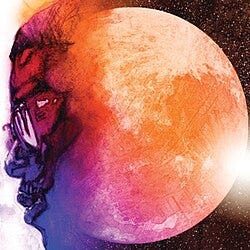
I recently attended a laser light show in a planetarium, where we listened to Kid Cudi’s first album ‘Man on the Moon: The End of Day’ and looked up at trippy space visuals.
As a menagerie of YouTube LSD videos looped in front of me, I thought a lot about my youth. This album was intrinsically tied to the development of my friends and I, and probably the vast majority of other people my age who also liked hip hop and felt kind of sad in their teenage years.
For those who don’t know, the album tells the autobiographical story of Scott Mescudi, a kid from Cleveland who lost his father young and grew to be dependent on drugs to ‘escape the torment of reality', as he puts it. As we listen, we walk alongside a Lost Boy trying to find his place in the world, but unable to find himself first. Scott talks about how he tried sports to impress girls, but ended up being too artsy for it. How he suffers from night terrors and only feels alive under moon. How his mother knows he stays on drugs and how his father would be proud of him.
Every song on that album, the highs and the lows, resonated with our angsty and melancholy youth. It was the music that made us feel seen, and let us connect with each others shared experience without having to be the first to speak our sadness. Scott took that strangely warm and comfortable longing and set it to sounds that felt dreamy and ethereal, which let us drift along in that void, nurtured by it.
I have vivid memories of snowboarding while listening to Solo Dolo (Nightmare), feeling closed into myself, alone on a snowy mountain. The world was quiet except for Scott telling me:
‘Why must it feel so right when I know that it’s wrong. When will I ever learn from the words in my song’.
It was peaceful and empty and real, the kind of deep ache you only get from quiet snow and a hollow world.
I know firsthand that dozens of people in my class felt this same way, and judging by the crowd of millenials at the show, it’s probably a very wide phenomenon, and probably not limited to my generation.
Kids younger than me grabbed on to SoundCloud rappers who talked openly about abusing pills and ideating suicide. People older than me modeled their worldviews through Kurt Cobain. Emo music and lyrics like “I’m just a kid and life is a nightmare” highlight how well it bends across genres, with every lunch table having its own dark anthems. Wells of melancholy seem to be the favorite hangout of young people for every generation.
But why?
Kid Cudi’s story specifically links his depression to an uprooting of safety. Scott has mentioned many times that he began to disconnect and slip into darkness at the loss of his father, which shook the foundational mainstay of his youngest years. A dependable column that supported his entire life and provided feelings of protection was stolen away by cancer, and suddenly replaced by only a void. With no support underneath him that felt like it couldn’t be snatched away at any moment, Cudi drifted.
In short, Cudi lost his innocence.
As kids, we’re supposed to be sheltered by our parents, our family, our teachers, and the community. There is safety and security, and an implicit understanding that things will be ok because the adults know how to navigate the world. The world has conflict, but our awareness has not yet captured how it may directly affect us yet.
Then, a moment comes that strips it away. Each of us eventually has the curtain pulled back, a brutal moment when we realize the potential danger of the world. Hopefully the world is kind enough to postpone it as long as possible, but it eventually comes.
I see it in my own family, as my niece tells us her ex’s new girlfriend got his name tattooed on her neck. They’re all 15 years old. The level of manipulation and pressure and shady situations that created a situation where a 15 year old has a neck tattoo of a boyfriend’s name should not be a part of her world yet, but it is. I remember her clearly as a 6 year old, with big, bright eyes and endless, bubbling energy. In my head, I see her singing along to Disney movies, in that funny kid way where she can’t really say her R’s. This memory of purity is grossly juxtaposed over the current half-glazed, burdened expression on her face, and her distance from joy is tangible.
Many young people go through this around middle school (and sadly some much before), in a phase when the world becomes unkind. Unnecessary cruelty can come from any direction, including other children. That rapid disintegration of shelter leaves deep impressions, and having the emotional awareness to understand and label it is well beyond most children’s capabilities.
What’s left instead is a deep void where the security was before, a dark cave that a much larger presence inhabits, with the enormity of the world and its dangers making you feel very, very small.
Then we find the music. The angst of being misunderstood and angry is spelled out for us by others, using the words that we couldn’t quite piece together ourselves. The emotions that were nothing but swirling colors inside are brought to us as crashing drums, cutting lyrics, and dark themes. It’s remarkable to be so seen. You hear the lyrics and realize that you’ve felt the lyrics before.
This music will bring together the immense waves of frustration, helplessness, bitterness, triumph, and devil-may-care rebelliousness, helping to build our adolescent identity. Unspoken validation will bond us to our friends as the records play loudly in our first symbols of freedom: our cars. Our first deep discussions will be sparked by emotions newly labeled by our favorite artists. We find peer communities and companionship forged by the loss of innocence.
And it may be the last time we ever feel so wonderfully raw and alive.
Eventually, we grow up. We become more emotionally stable, our lives ushered forward by routine and duty, and our responsibilities precede our passions. There is a reason many revolutions are sparked by college students, in their last fiery glint before true adulthood, and it is because the strength of these unnamed emotional waves are a revolution in themselves.
Unfortunately, passion is often not the part of the brain best suited for a cohesive society, where many people live and work together. We all adhere to rules in hopes that others will do the same, so that we may all progress forward together. The tallest structures are built on sturdy foundations, and raw emotion is anything but sturdy.
But sometimes those albums come back on, the ones that found us in a vulnerable disarray and helped us give the world structure again. Those albums bring us back to the void, the time before things were named, when they were only felt, and felt powerfully. When we were wrapped in the embrace of melancholy, shedding our childhood and innocence so that we may become part of the world.
And for that brief break from adulthood, while that album plays back memories, melancholy is met as a familiar old friend.
With love, from me to you,
Deacon